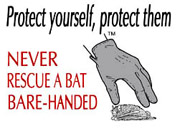
 The
first concern many people have about bats is rabies. Like most mammals,
bats can contract rabies. However, less than one half of one percent of
bats actually catch the disease. Additionally, sick bats do not seek
people out for attack; they generally search for a secluded spot to die
quietly. According to the Center for Disease Control, people cannot get
rabies from just seeing a bat in an attic, in a cave or at a distance.
In addition, people cannot get rabies from having contact with bat guano
(feces), blood, or urine or from touching a bat on its fur (even though
bats should never be handled).
The
first concern many people have about bats is rabies. Like most mammals,
bats can contract rabies. However, less than one half of one percent of
bats actually catch the disease. Additionally, sick bats do not seek
people out for attack; they generally search for a secluded spot to die
quietly. According to the Center for Disease Control, people cannot get
rabies from just seeing a bat in an attic, in a cave or at a distance.
In addition, people cannot get rabies from having contact with bat guano
(feces), blood, or urine or from touching a bat on its fur (even though
bats should never be handled).However, if you are bitten by a bat, or if saliva from a bat gets into your eyes, nose or mouth, seek medical attention immediately. Whenever possible, the bat should be captured and sent to a laboratory for testing. In addition, bats that are found in a room with a person who cannot reliably rule out physical contact (for example a sleeping person, a child, a mentally disabled person or an intoxicated person) will need to be tested for rabies. If contact has occurred or is suspected call your personal physician or local health department immediately. If contact has not occurred please proceed to the links above to obtain step-by-step directions on how to safely rescue the bat.
A BAT FOUND FOUND INDOORS
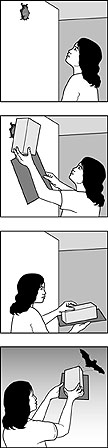
1. Wait until the animal is motionless. A bat that is flying is almost impossible to catch, and you have a greater chance of injuring the bat if you attempt to capture it while it is airborne. In addition, bats that are caught while flying frequently panic and attempt to bite. Be patient. Wait until the bat lands and is still, and then proceed to step 2.
2. Contain the bat. Quietly approach the bat, and wearing thick gloves or using a thick towel, gather the bat up (holding it securely but not tightly) and place it into a box or similar container with a lid. Or instead, simply place a box, waste can, coffee can or similar object over the bat where it has landed. Then, take a piece of cardboard and gently slide it between the box and the surface the bat is on (i.e. floor, wall or ceiling). Keeping the cardboard in place, gently turn the container right side up. If the bat is captured during the day proceed to step 5. If the bat is captured at night and does not appear to be a baby bat, proceed to step 3. Important note!: Do not place the bat in a bird cage or container with small openings. Bats are very intelligent and can easily squeeze through a 1/4 x 1/2 inch crack.
3. Release the bat outdoors at nightfall. Once the bat has been captured, take the container outdoors. Take a flashlight and a towel or gloves with you in case the bat has problems flying away. Find an elevated area (such as a deck or ladder), lift the box over your head, and tilt it to the side so the bat can fly out (the bat will not be able to fly out of a grounded container in a vertical position). Proceed to step 4. (Note: Do not release the bat during the day or during cold or bad weather. Instead, proceed to step 5).
4. Watch it leave. Use the flashlight to watch the bat fly away. If the bat does not fly away, or attempts to fly but seems unable to, it is likely that is has an injury or illness. It may be a disoriented juvenile, or it may simply be dehydrated or starved from being trapped indoors. If this is the case, use the towel or gloves (not bare hands) to gather the bat up. Keep the bat in the closed container and put it in a safe place that is free of children, pets, fire ants or other hazards, and proceed to step 5.
Note: It is not safe to attempt care for the bat on your own – bats should only be cared for by trained, vaccinated individuals. Furthermore, in order to survive, bats in this condition may need injections of electrolytes in addition to specialized food and caging.
5. Call a local wildlife rehabilitator for assistance. Please see LOCATE A RESCUER.
Note: The information contained in this text regarding health and/or safety precautions may not be adequate for all individuals and/or situations. It is the readers obligation to comply with all applicable laws and regulations.
A BAT FOUND FOUND OUTDOORS
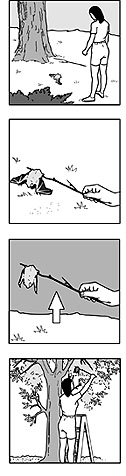
1. Make sure the bat is safe from predators. Have someone stand guard over the bat so it does not fall prey to domestic pets, fire ants or blue jays. If the bat remains quiet and still, proceed to step 2. If the bat panics as described above, proceed to step 5.
2. Do not use your hands to help the bat. Instead, gently touch a small tree branch (two or three feet in length) to the bats feet. This usually initiates a grab reflex and the bat will grip the branch with its toes. When you lift the branch you can inspect the bat (or mother bat with babies) for any injuries. If the infants are clinging to the mother and there are no apparent injuries, proceed with step 3. If injuries are detected, proceed to step 5.
3. SLOWLY move the bats into the branches of a nearby tree. This must be done very carefully. A sudden move may cause a mother bat to fly off and abandon her young. Using a ladder, gently secure the branch into a spot where foliage and leaves conceal the bats. The spot should be on a branch at least six or more feet from the ground, with a clearing below to enable the bat to take flight. (Do not place the bats on the trunk of a tree where they will be vulnerable to predators.) Proceed to step 4.
4. Monitor the area. Check the area the following morning. If the bat has remained in the same position overnight it may have an undetected injury or illness. If the mother bat is gone but her babies remain, the babies may have been abandoned. Proceed to step 5.
5. Call a local wildlife rehabilitator for assistance. Please see LOCATE A RESCUER.
PROVIDING TEMPORARY CARE:
DO NOT handle a bat with bare hands, and do not attempt to rehabilitate the bat on your own. To do so could jeopardize your safely as well as the life of the bat. Please also read the information below to provide temporary care for the bat until help is obtained.Line a box with an old t-shirt so the bat has something to hang upside-down on. Create some pleats in the shirt so the bat can hide if it wants to. (Make sure any tape that is used is secured well so the bat won’t get stuck.) Put a small amount of water in a small, shallow container like a baby food jar lid. Place the lid on the bottom of the container and next to a wall so the bat can hang over it to drink. Make sure a top is secured to the box as some bats can squeeze through a crack as thin as 1/4″! If you must handle the bat please remember to wear thick gloves (even though rabies is rare in bats, if it bites you it will need to be euthanized and tested). Until help is located, keep the box in a room where the bat won’t get too warm or too cold. and keep the bat away from children and pets.
PLEASE REMEMBER: Bat and wildlife rehabiltators are extremely busy, sometimes caring for orphaned and injured wildlife up to 18 hours per day. If you find a bat please DO NOT rely on email to get help since time may be critical to saving the bat. ALWAYS CALL a bat or wildlife rehabilitator nearest to your location. Also, please be aware that there may not be a bat rehabilitator in your town or even your state, however, some rehabilitators are willing to drive a good distance to help a bat in need. Most wildlife rehabilitators volunteer their time and money to save the animals, and they rely on the help of the public. Please consider transporting the bat to them, meeting them half way, and/or even making a donation.
More about Bat World Sanctuary:
Bat World provides information on what to do if you find a bat, including a list of rescuers located nationwide. Bat World educational information is available for teachers and children alike. Free bat house plans are available at Bat World, or you can buy one pre-made. There is even information on how to handle bats getting into your business or your home. Bat World information on myths and facts and even bat rabies can be found at batworld.org. Plus you can shop online at Bat World for bat books, bat jewelry, t-shirts and even wine and candles. Volunteer with Bat World online and sign up for Bat World Action Alerts. And you can even sponsor a bat in need!
I LOVE BAT WORLD SANCTUARY!
I LOVE BAT WORLD SANCTUARY!
